We have been supporting aspiring IBCLCs with resources, information and education since 2010, and continue to lead the way in preparing future Lactation Consultants. How can we help you?
|
I'm ready to go from "start to certified" with Lactation University
|
I would rather watch the free video to learn how to become a IBCLC
|
I would rather read through all the requirements to become an IBCLC
|
There are academic prerequisites and and clinical hours required to sit the IBLCE Board Exam to become an IBCLC. The information below provides information on all the requirements to become an International, Board-Certified Lactation Consultant (IBCLC).
To Sit the IBCLC Exam, You Must Complete 3 Requirements1. College Courses: Lactation University provides a list of budget-friendly options
2. Lactation Specific Education: Lactation University provides all hours required 3. Clinical Hours: LU students can earn clinical hours through the LUVS Program |
Important to Know:
|
Lactation University Does Not GatekeepWe want our students to succeed and become a part of the essential feeding team for families. We believe a thorough foundation, rooted in evidence-based education creates a confident, skilled clinician. We teach professionals to thrive in a career, not just pass an exam. |
The requirements can be completed in any order or simultaneously. Since the college courses do not expire, and the lactation-specific and clinical hours MUST be completed within 5 years of applying for the exam, some students complete the college courses first, or have a clear plan to meet them in time to apply for the IBLCE exam.
Requirement 1: College Courses
|
It is a myth that you have to be a medical professional to become an IBCLC or to select Pathway 1. The myth may have originated from the fact that nurses have already met the college course requirements. If you are on the list of health professionals recognized by IBLCE, you do not have to take any additional classes, if not, you must take the required courses.
|
If you have earned a degree as a health professional recognized by IBLCE, skip to Requirement 2. It is understood that you have already met all of the educational standards and in case of an audit, you would show your proof of license/certificate.
If you do not possess a current degree, you will need to fulfil this prerequisite prior to applying for the exam. The college courses (unlike other requirements) never expire. If you completed classes decades ago, they are still applicable. There are several low-cost options for completing the college courses on a budget. Even students who attended college courses during high school can use the credits earned towards these requirements. |
If you are not certain whether or not a course would meet the class requirements, check the description of the class in the college catalog not just the course title. For instance, a student might have completed a math course that would qualify for the statistics requirement if the catalogue includes statistics in the course description.
There are 14 subjects that are required to sit the Board Exam. IBLCE provides a graph of all 14 requirements.
Candidates who are not one of the health professionals listed by IBLCE must complete the following 8 health science courses:
|
|
Criteria for the 8 health science courses
- Provided by an accredited institution
- Minimum of one academic credit session (semester, quarter, etc.)
- Earn a passing grade
All of the required courses can be completed online in a short amount of time. Several learning platforms have passed IBLCE audits and are a budget-friendly way to complete the education. Two of the online learning platforms that have passed IBLCE audits include Straighterline and Sophia. Candidates could also enroll in their community college to secure their credits. It is feasible to complete all of the health science classes and additional bundle for around $400.
BONUS INFORMATION: Human Biology counts for 3 courses (Biology, Human Anatomy and Human Physiology). A discerning students can take as few as 6 classes to fulfill all 8 requirements.
BONUS COURSE INFORMATION FOR UNITED STATES CANDIDATES:
Several courses (Biology, Human Growth and Development, Introductory Psychology, Introductory Sociology) can be credited through CLEP Exams. These are independent study modules that grant credit by exam. Each course has recommended reading and textbooks to complete before sitting the exam. The cost is $90, plus the test center exam fee, plus the cost of the textbook.
https://clep.collegeboard.org
DANTES Subject Standardized Tests (DSST) are also accepted for credit by IBLCE. A student can complete two health science courses, Fundamentals of Counseling and Lifespan Developmental Psychology, by passing a DSST exam.
DSST, offers suggested preparatory study resources (for a fee), and an exam fee of $100. Students must take a test at an approved site (fee varies).
https://www.getcollegecredit.com/dsst-exams/
BONUS INFORMATION: Human Biology counts for 3 courses (Biology, Human Anatomy and Human Physiology). A discerning students can take as few as 6 classes to fulfill all 8 requirements.
BONUS COURSE INFORMATION FOR UNITED STATES CANDIDATES:
Several courses (Biology, Human Growth and Development, Introductory Psychology, Introductory Sociology) can be credited through CLEP Exams. These are independent study modules that grant credit by exam. Each course has recommended reading and textbooks to complete before sitting the exam. The cost is $90, plus the test center exam fee, plus the cost of the textbook.
https://clep.collegeboard.org
DANTES Subject Standardized Tests (DSST) are also accepted for credit by IBLCE. A student can complete two health science courses, Fundamentals of Counseling and Lifespan Developmental Psychology, by passing a DSST exam.
DSST, offers suggested preparatory study resources (for a fee), and an exam fee of $100. Students must take a test at an approved site (fee varies).
https://www.getcollegecredit.com/dsst-exams/
The remaining 6 subjects, can be completed by an institution of higher learning or continuing education courses.
- Basic Life Support-must be current
- Medical Documentation
- Medical Terminology
- Occupational Safety and Security for Health Professionals
- Professional Ethics for Health Professionals
- Universal Safety Precautions and Infection Control
These 6 subjects, can be completed by an institution of higher learning or continuing education courses. CPR is often provided as a community class through public health or local hospitals. Students can purchase 5 of the 6 in a bundle (BLC/CPR not included) for as little as $89.
Requirement 2: 95 Hours of Lactation -Specific Education
5 hours must focus on communication and 2 must focus on the WHO Code
Lactation University provides all of the required lactation educational hours
Every pathway requires at least 95 seat hours (60 min hours) in human lactation and breastfeeding. Five of the 95 hours must focus on communication and two must focus on the WHO Code. These hours must be completed within 5 years of applying to sit the IBLCE Exam. The required hours can be secured in a variety of ways. IBLCE allows for education to be achieved through in-person conferences, online webinars, distance learning and independent study modules.
There are currently only 2 programs that offer a clinical component for their students, and only Lactation University includes the cost in registration. LU students can earn clinical hours through the LUVS Program.
- Education is not required to be from an IBLCE verified Continuing Education Recognition Points (CERP) Provider
- Education must be on topics that are specific to lactation and breastfeeding, examples of which can be found on the IBCLC Detailed Content Outline.
- IBLCE uses a 60-minute hour to calculate the education hours.
There are currently only 2 programs that offer a clinical component for their students, and only Lactation University includes the cost in registration. LU students can earn clinical hours through the LUVS Program.
Are you ready to trust Lactation University to take you from start to certified? We demystify the credential and simplify the process. |
Requirement 3: Clinical Hours
LU students can earn clinical hours through our IBLCE-approved program, making it possible to complete all 3 requirements simultaneously
The clinical hours are by far the most difficult prerequisite for sitting the IBLCE Exam. LU has removed this barrier with its IBLCE-Approved Breastfeeding Counselor Program.
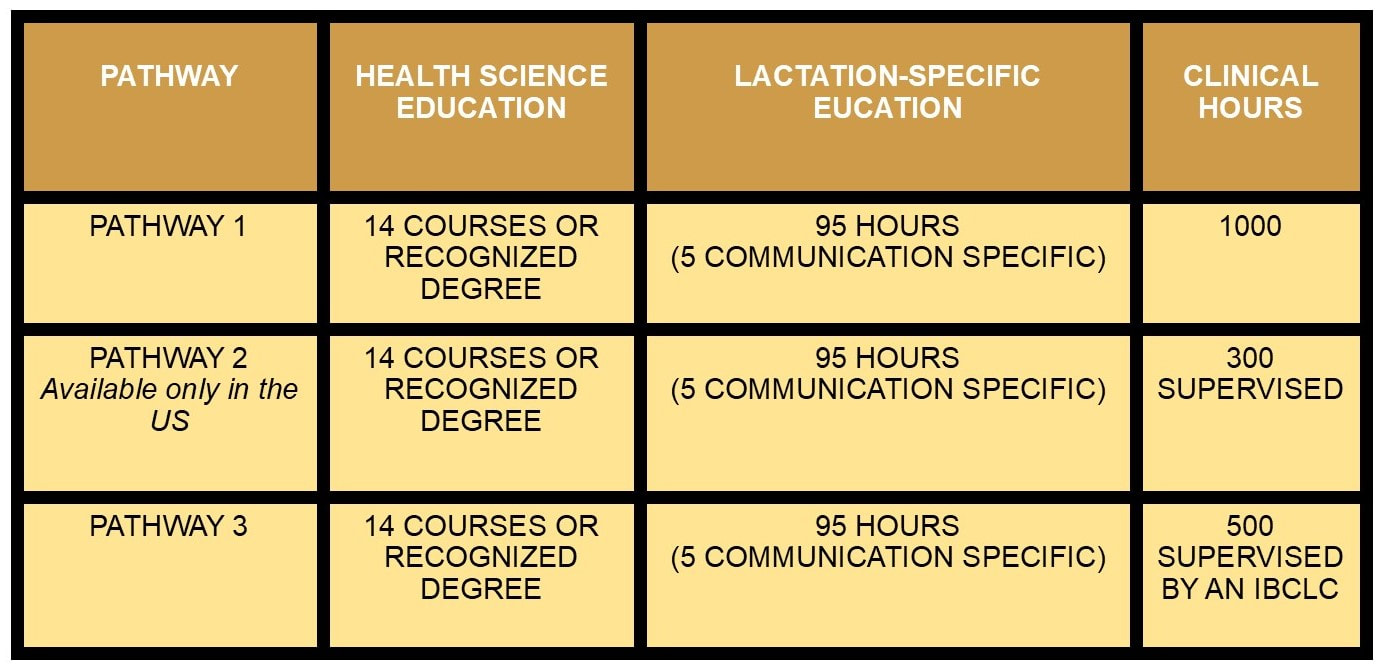
Pathway 1 (working or volunteering as a breastfeeding support counselor) candidates are required to document 1,000 clinical hours in an appropriate supervised setting. They do NOT have to be directly supervised by an IBCLC. If a candidate works for a hospital or clinic, and they get audited, a person in a supervisory position would have to attest that the student completed the necessary hours. If an aspiring IBCLC is earning their clinical hours through an approved Breastfeeding Counselor Program, the program has already established a way to train their volunteers, document clinical hours, provide necessary supervision and require adherence to a Code of Ethics and required continuing education. Our LUVS program earned IBCLE recognition in 2022. In order to earn clinical hours through Lactation University LUVS Program, a student must complete the FLE or enroll in the LU 95+ Hours IBCLC Prep Course.
Lactation University FLE and CLP students can earn clinical hours through our LUVS program AND can combine the hours they earn in their private practice. Our IBLCE-approved program allows doulas, NCS, SLPs, Midwives and other perinatal providers to count the hours providing breastfeeding support and education. Earn clinical hours faster combining volunteer and paid positions. |
Applicants who select Pathway 2 (enrolled in an accredited academic lactation program), must provide 300 hours of directly supervised lactation support by an IBCLC. Some institutions find mentors or have a way for students to earn their clinical hours, others only provide education and require candidates to secure their own mentors. It is imperative that students understand what is included in their tuition.
Applicants who choose Pathway 3 (shadowing and mentoring by a current IBCLC), must document 500 supervised hours. Although one IBCLC must agree to be the main mentor, other IBCLCs can be included to help students reach their clinical hours requirement. Candidates cannot begin counting their clinical hours until their application for Pathway 3 has been accepted by IBLCE and they have observed their IBCLC mentor for an unspecified number of hours.
Select Your Best Pathway 1, 2 or 3
Consider the pathway choice carefully. Each pathway has pros and cons. A candidate's job or volunteer position can help determine the best pathway. Financial investment can also be a factor is selecting pathways. Each pathway has the same requirements for lactation education and college courses, but the number of clinical hours and how they are met will vary. Pathway 1 requires 1,000 clinical hours; Pathway 2 requires 300 clinical hours and Pathway 3 requires 500 clinical hours. The Pathways and requirements will be further detailed below.
Pathway 1:
Recognized Health Professionals and Recognized Breastfeeding Support Counsellors
Many people find Pathway 1 to be the most affordable and obtainable pathway. This pathway is best suited for those working in a hospital, birth center, community clinic, lactation care clinic/practice, or a primary care practitioner's practice/office. Some candidates find employment as a WIC Peer Counselor in order to earn these clinical hours as a paid employee. Each WIC agency has their own requirements and budget for peer employees. All employees must have breastfed their own baby, some for as long as a year. Health professionals, such as nurses, often select Pathway 1 if the work in labor and delivery or postpartum. All direct client education and support around breastfeeding can be counted.
If an individual wants to pursue pathway 1, but does not have a position in healthcare, they can earn their clinical hours through an IBLCE approved Breastfeeding Counselor Program. Lactation University has established the LUVS program to help advocates earn the clinical hours necessary to qualify for the exam. Our LUV Staff can facilitate in-person/virtual support groups or book clubs to accumulate the 1,000 clinical hours. The option is open to those who have attended a FLE or CLP course through Lactation University.
Pathway 2:
Accredited Lactation Academic Programs
Pathway 2 is currently only available in the United States. Students must complete a comprehensive academic program in human lactation and breastfeeding that is accredited by CAAHP (or another accrediting body with equivalent accreditation standards). Currently, there are 11 options with only 2 providing online availability. The cost of these programs range from around $10,000 to $50,000. Most institutions do not accept financial aid or tuition assistance. Check directly with the institution to view their fees and stipulations. Pathway 2 students are still required to complete the 14 health science college courses. A few universities will incorporate all or a portion of the health science classes through their program or require them as a prerequisite that must be met prior to enrolling.
Pathway 3:
Mentorship with an IBCLC
Pathway 3 only requires 500 clinical hours, but each one MUST be directly supervised by an IBCLC. In order to pursue this pathway, aspiring IBCLCs must locate a current IBCLC that is willing to act as a chief mentor. Candidates can have several IBCLC mentors, but one must take on the role of Chief Mentor, complete the application and assume responsibility for the mentee. Mentors will require an "unspecified amount of time" shadowing prior to allowing mentees to perform consulting duties. This time frame should be discussed prior to making a commitment. A good mentor/mentee relationship is vital.
Many mentors charge a fee (ranging from $5-$10 an hour) for the extra workload and responsibility of supervising. Aspiring IBCLC are also benefiting from their reputation and established practice. Some will offer their services for free or are open to bartering. Mentors may also include a "non-compete" clause if you will be practicing in the same community following your certification. Communication is vital for this pathway.
IBLCE also requires an application and Mentor Agreement Form to be submitted and approved prior to entering into a contract with a mentor. The application fee established by IBLCE is $50-$100 based on the tier of the country the application originates from ($100 US fee). Although this pathway has 500 clinical hours required (half of Pathway 1) each clinical hour must be directly supervised by an IBCLC.
It can be challenging to find a willing IBCLC with a busy enough practice to take on a mentee. If this option is available, it is a great way to learn applicable skills and learn first-hand from a practicing Lactation Consultant. With any pathway, having an IBCLC to even informally mentor is an asset.
Many mentors charge a fee (ranging from $5-$10 an hour) for the extra workload and responsibility of supervising. Aspiring IBCLC are also benefiting from their reputation and established practice. Some will offer their services for free or are open to bartering. Mentors may also include a "non-compete" clause if you will be practicing in the same community following your certification. Communication is vital for this pathway.
IBLCE also requires an application and Mentor Agreement Form to be submitted and approved prior to entering into a contract with a mentor. The application fee established by IBLCE is $50-$100 based on the tier of the country the application originates from ($100 US fee). Although this pathway has 500 clinical hours required (half of Pathway 1) each clinical hour must be directly supervised by an IBCLC.
It can be challenging to find a willing IBCLC with a busy enough practice to take on a mentee. If this option is available, it is a great way to learn applicable skills and learn first-hand from a practicing Lactation Consultant. With any pathway, having an IBCLC to even informally mentor is an asset.
Still Have Questions? Join Our FREE Webinar.
|
The How to Become an IBCLC Webinar discusses:
|